When the Waistcoat Left the Suit
When did the waistcoat leave the suit? Trace its gradual shift from standard layer to optional choice, and learn what its presence signals today.
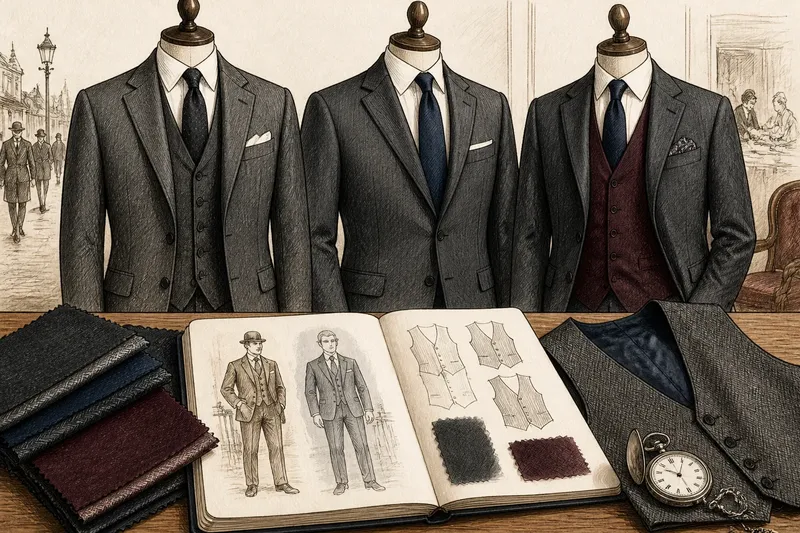
The waistcoat left the suit by degrees, not on a single date. In the late nineteenth and early twentieth centuries, the three-piece suit remained a familiar ideal, but two-piece suits became an increasingly accepted choice for everyday wear.
Why did the waistcoat belong to the suit?
For much of the suit’s history, coat, waistcoat and trousers were treated as a coordinated outfit. Matching cloth linked the pieces, while the waistcoat covered the shirt front between jacket and trousers.
That layer mattered when shirts were generally treated as undergarments rather than as a visible part of an outfit. With the jacket open, a waistcoat kept the front looking composed; it also allowed some variation in colour and fabric without abandoning the suit’s overall arrangement.
When did the waistcoat leave the suit?
There was no universal turning point. The three-piece suit remained established through the late nineteenth century and into the twentieth, while the two-piece suit gained ground as a complete outfit. The timing and pace varied by place, occasion and wearer, so it is more accurate to describe a gradual shift than to name a year when waistcoats disappeared.
As shirts became more acceptable to show beneath an open jacket, the waistcoat was less necessary as a covering layer. Jackets and trousers could read as a finished combination on their own. Changing expectations around work and leisure also made a simpler suit useful in settings where a third layer felt more formal than required.
These developments help explain the shift, but they were not a single cause or a uniform change in dress. Three-piece suits continued in formal settings and tailored wardrobes. The waistcoat moved from a common part of the suit to an optional piece chosen for its particular effect.
What does a waistcoat add to an outfit?
Once a two-piece suit could stand alone, a waistcoat became a more deliberate choice. Its effect depends on its cloth, fit and setting:
- Continuity: A waistcoat in the suit’s cloth makes the three pieces read as one coordinated outfit.
- Contrast: A different colour or texture draws attention to the middle layer and gives the suit a more individual feel.
- Coverage: It fills the space between shirt and jacket, changing how much of the shirt is visible.
- Formality: In a setting that suits tailored dress, a waistcoat can make the outfit look more ceremonious.
- Warmth: The extra layer may be useful when a shirt alone feels too light, though it adds warmth indoors too.
A waistcoat can also be worn without a jacket if the occasion suits it and the garment is presentable on its own. Then the fit of the waistcoat, shirt and trousers carries more of the outfit’s visual weight.
How can you tell what role a waistcoat plays?
Start by comparing its fabric with the jacket and trousers. Matching cloth usually signals a three-piece suit; a different colour or texture makes the waistcoat read more like a separate layer. Then consider the shirt and jacket: with the jacket open, the waistcoat is visible between them; without the jacket, it becomes the main tailored garment.
Say you have a charcoal two-piece suit and a burgundy waistcoat, and you are dressing for a family celebration. If you wear the waistcoat, its contrast becomes a clear feature of the outfit; if you leave it out, the suit keeps a quieter, more continuous appearance. The choice turns on the look you want and the event’s expectations, not on a rule that every suit needs a third piece.
It is not worth adding a waistcoat just to make a suit seem more historically correct. Clothing conventions changed, and the older three-piece arrangement is not a missing part of every modern suit.
How do you decide whether to wear a waistcoat?
Check the occasion, the suit and the way the outfit feels together. Use each observation to make a clear choice:
- Dress expectations: If the invitation or organiser calls for formal tailored dress, consider a matching waistcoat; if the event is relaxed, a two-piece suit may be the more suitable choice.
- Desired effect: If you want a continuous three-piece look, choose a waistcoat in the suit’s cloth; if you want contrast, select a different fabric or colour, or leave it out for a simpler outfit.
- Shirt visibility: If you want the shirt front visible beneath the jacket, wear the suit without a waistcoat; if you prefer more coverage, add one.
- Indoor comfort: If another layer feels comfortable for the room and length of the event, keep the waistcoat in the outfit; if you feel too warm or restricted, leave it off.
- Fit in motion: If the waistcoat sits smoothly beneath the jacket when you sit and move, wear the combination; if it pulls or bunches, choose the two-piece suit or ask a qualified tailor about adjustments.
For cleaning and storage, follow the garment’s care label; for alterations, consult a qualified tailor. Those practical details protect the clothes, while the style decision depends on the occasion and the effect you want.
What do readers ask about the waistcoat’s changing place?
Was a waistcoat always part of a suit?
It was central to many coordinated suits, especially when coat, waistcoat and trousers were conceived as one outfit. It was not an unchanging rule for every kind of dress, and two-piece suits increasingly offered a complete alternative.
Why did two-piece suits become acceptable?
A jacket and trousers could look finished without a waistcoat, while a visible shirt no longer had to be covered in the same way. The shift was gradual and varied across settings rather than the result of one change alone.
Does a waistcoat make an outfit more formal?
It often gives a suit a more formal or carefully assembled appearance, particularly when it matches the other pieces. A contrasting waistcoat can instead make the outfit more expressive, so the cloth and occasion both matter.
Can you wear a waistcoat without a jacket?
Yes, if the setting suits that level of dress and the waistcoat looks finished on its own. Without a jacket, its fit and relationship to the shirt and trousers become more prominent.
What does the waistcoat’s history tell us?
The waistcoat’s changing place shows how a suit can shift from a fixed arrangement towards a choice of layers. When you consider whether to wear one, think about the occasion, the cloth and the role you want it to play; the waistcoat left the suit as a default, but remains useful when it contributes something specific.