The Quiet Work of a Jacket Lining
A jacket lining affects movement, comfort and finish. Learn how to check its back, sleeves, seams and hem so you can choose a jacket that feels right.
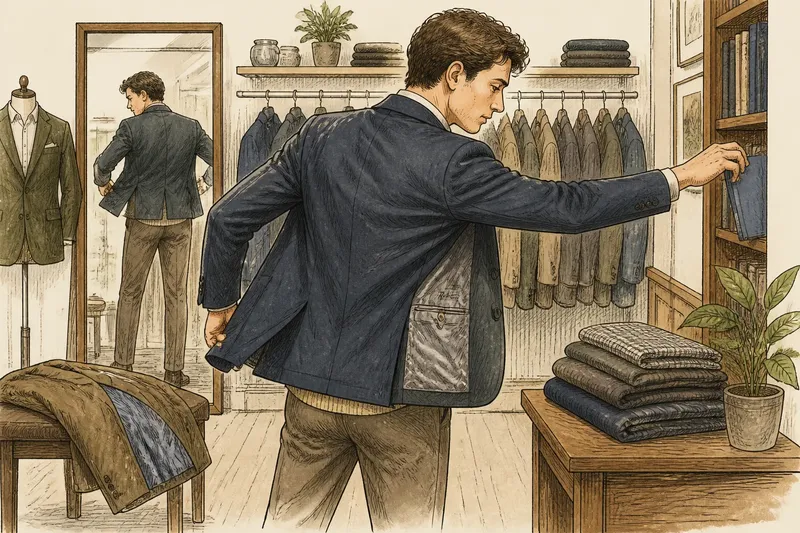
A jacket lining can make reaching for a book feel easy or leave the back tugging against your shirt. Check how the jacket moves on your body, not just how its lining looks on a hanger.
How does a jacket lining affect movement?
The lining gives clothes beneath the jacket a smoother surface to slide against. Its shape matters too: a little ease across the back and under the arms lets the inner layer move without pulling tightly on the outer fabric.
While wearing the jacket, reach forward as if taking a book from a shelf, then lower your arms. Notice whether the back rides up, the sleeves tug or the hem settles again. These signs can reflect the jacket’s overall fit as well as the lining.
Why does the lining have folds at the back or hem?
A centre-back fold or pleat gives the lining room to spread as your shoulders move. It should open naturally and lie flat again when you relax. Near the lower back, a short fold can let the lining move as you sit or walk; a lining pulled tightly across the hem may restrict that movement.
Say you are comparing two jackets on a shop floor. One has a centre-back fold sewn firmly shut and pulls when you reach forward; the other lets you reach without the back tightening. The first may feel more restrictive in that movement, while the second is the easier choice for your needs.
What can the sleeves tell you?
Your arm slides against the sleeve lining when you put the jacket on and move. Feel the inside near the cuff and check that the lining does not catch against your shirt or twist around your forearm.
Look at where the lining meets the cuff. It should sit inside the sleeve without bunching into a thick ridge or hanging out when your arm is relaxed. If the sleeve twists, check the jacket’s overall fit as well; the lining is only one possible cause.
Does the lining material matter?
Different materials feel and move differently. A slippery surface may make layering easier, while a softer or more textured one may feel comfortable against a light shirt. Consider what you normally wear underneath and whether the lining feels too stiff or substantial for the outer cloth.
Care depends on the material and the jacket’s construction. Follow the care label and maker’s instructions rather than treating the lining as a separate washable item. If the label is unclear or the lining needs repair, ask a professional cleaner or tailor before proceeding.
What should you check when choosing a jacket lining?
Try these checks while wearing the jacket, if possible. Each one links an observable detail to a practical decision:
- Back ease: Check whether the lining lies taut across your upper back at rest. If it does, reach forward; if it pulls, try another size or cut, and if it does not, continue checking the fit.
- Hem movement: Sit and stand, noticing whether the lower lining tugs. If it restricts movement, compare another jacket; if it moves freely, check the remaining details.
- Sleeve finish: Bend and straighten your arm and see whether the lining bunches or hangs beyond the cuff. If it does, try another sleeve fit; if it stays inside and feels smooth, keep assessing the jacket.
- Seam comfort: Feel for bulky ridges or loose threads inside. If a seam rubs, choose another garment or ask whether a tailor can address it; if it lies flat, note that it feels comfortable.
- Armhole comfort: Raise and lower your arms. If the lining catches or pulls the jacket upwards, try a different size or cut; if it moves without tugging, check how the jacket feels at rest.
- Noise and cling: Move your arms and notice persistent rustling or static-like cling. If either would bother you in ordinary wear, compare another lining; if not, decide based on the other fit and comfort checks.
It is not worth judging a lining by colour alone or searching for a particular lining-fabric brand. A bold print cannot tell you whether the jacket allows comfortable movement.
What else might you want to know about a jacket lining?
Can a jacket be unlined?
Yes. An unlined jacket has no full inner layer, though it may still have lining in the sleeves or selected areas. Inspect exposed seams and consider how the jacket feels over the clothes you usually wear.
Is a loose lining always a problem?
No. Some ease lets the lining move with your body without holding the outer shell back. Excess fabric that twists, catches or hangs awkwardly is different from a deliberate fold designed to allow movement.
Can a lining be replaced?
A tailor may be able to replace a worn or damaged lining, depending on the jacket’s construction and condition. Ask for an assessment before deciding whether repair is suitable.
Should the lining match the outer fabric?
Not necessarily. A contrast lining is a design choice; a discreet one keeps attention on the jacket’s exterior. Choose the look you prefer, then assess comfort and movement separately.
How can you assess a jacket lining as a whole?
Assess the jacket lining in motion: check the back, sleeves and hem, then try it over a familiar shirt or knit if you can. When comparing jackets, notice which one lets you reach, sit and relax without tugging or bunching.
That easy movement is more useful than a striking pattern when judging everyday comfort. If a jacket feels good at rest but pulls as soon as you move, keep looking for a cut and lining that work together.