The Matching Outfit Myth: Why Exact Sets Can Feel Flat
The matching outfit myth says every detail must agree. Learn how to keep a look coherent while using contrast in shape, texture and accessories.
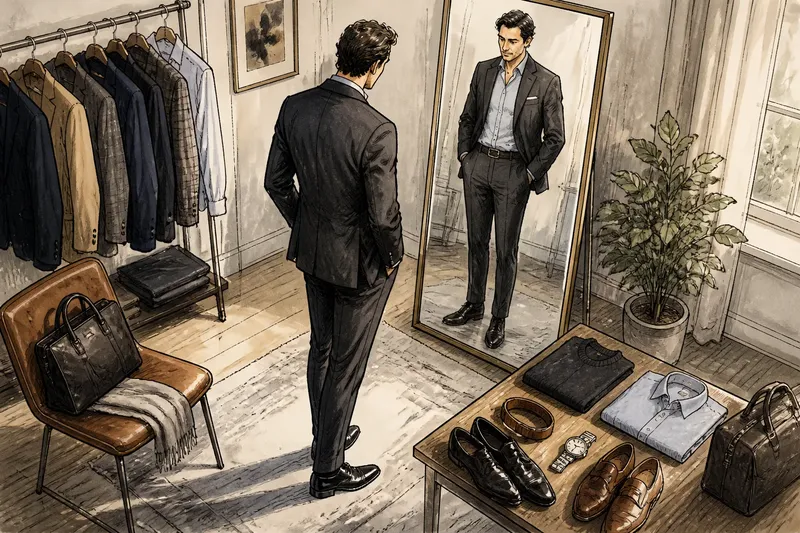
The matching outfit myth can leave a carefully coordinated look feeling oddly lifeless: the jacket, trousers, shoes and bag all agree, but nothing catches the eye. A coherent outfit needs a connection between its pieces, not a perfect copy of colour, texture and shape from head to toe.
If your clothes look too uniform, the answer is rarely to add another matching accessory. Find the element that has been repeated too often, then change one thing at a time: silhouette, surface, colour or scale. That keeps the outfit readable while giving it some movement.
Why does an exact match sometimes feel flat?
When every item repeats the same visual cue, the eye has little to compare. A navy blazer, navy trousers, smooth leather shoes and a navy bag may form a tidy column, but if their shapes and finishes are equally restrained, the outfit can feel more like a uniform than a considered combination.
Matching itself is not the problem. Repetition can make a look feel deliberate, especially when a set has a clear shape or a strong colour. The flatness tends to appear when colour, material, formality and scale all repeat at once, leaving no small interruption to give the eye a place to pause.
What if the outfit looks too formal or uniform?
What usually causes it: Several pieces share the same level of polish and structure. A crisp jacket with pressed trousers, a formal shirt and glossy shoes can make even a relaxed colour palette read as businesslike.
What to try: Keep the main colour connection, but soften one part. A fine-knit top under a tailored jacket or a less structured bag can shift the mood without making the outfit look accidental. If you prefer to keep every garment formal, try changing the silhouette instead: a longer jacket over a straighter trouser creates a different outline.
How can you add interest without adding another colour?
What usually causes it: The outfit relies on colour alone to create variation, so a restrained palette seems to offer no options. Yet texture and shape can separate pieces without introducing another hue.
What to try: Combine surfaces that respond differently to light: matte wool with a smooth cotton shirt, or a ribbed knit with a softly brushed coat. Keep the colours related, but let one fabric look crisp and another look soft. A narrow belt or a structured shoe can add a change in scale or outline as well.
Say you have a charcoal suit that feels too uniform with a charcoal shirt and polished black shoes. Keep the suit and shoes, then switch to a pale blue cotton shirt with a softly textured collar. The expected result is a clear colour break near the face and a small contrast in surface, while the dark foundation still ties the outfit together.
Why do the proportions seem wrong even when the colours work?
What usually causes it: Every piece may be similarly fitted or similarly loose. A close-fitting top with narrow trousers and slim shoes can look compressed; an oversized jacket, wide trousers and heavy shoes can make the whole outline feel broad and dense.
What to try: Change one proportion rather than replacing the whole combination. If the top and trousers are both close to the body, try a roomier jacket. If the outfit is loose throughout, choose a more defined shoe or a top that shows the shoulder line. Check the full outline in a mirror from a little distance, since small adjustments can look more pronounced up close.
What if the accessories look like a separate set?
What usually causes it: Shoes, belt, bag and jewellery have all been chosen to match one another, but they do not connect to the clothes in any other way. A group of identical finishes can look like an add-on rather than part of the outfit.
What to try: Link an accessory to one feature of the clothing instead. A leather belt can echo the tone of a shoe without being an exact match; a metal watch can pick up a button or zip. Let one accessory carry the connection and allow the others to differ in shape or finish. It is not worth hunting for an exact shade of leather if the pieces already sit comfortably together.
How do you troubleshoot a coordinated outfit?
Use this order so you can see what is helping and what is making the look too uniform:
- Choose the anchor: the garment you most want to wear, such as a checked blazer or a bright skirt.
- Identify what already connects the outfit, such as a shared colour, similar formality or repeated line.
- Look for the strongest repetition. If all the pieces are smooth, change texture; if all are fitted, change one proportion.
- Adjust only one feature, then step back and check the whole outline in a mirror.
- Keep the change if the outfit still feels connected and has a clearer point of interest; undo it if the contrast makes one item seem unrelated.
This sequence is more useful than adding several new details at once. When you change one feature, you can tell whether the issue was texture, proportion or an over-repeated colour, and keep the rest of the outfit intact.
Which small outfit questions are worth checking?
Can shoes and a bag be different colours?
Yes. They can relate through formality, finish or a colour already present in the clothes, rather than matching each other exactly. If they compete for attention, let one be simpler in shape or tone.
Does texture contrast work in a single-colour outfit?
Yes: a single-colour outfit can still combine matte, glossy, smooth or nubby surfaces. Keep the material contrast visible at a glance, rather than choosing textures so similar that they disappear together.
How many contrasting details should you add?
Start with one deliberate change, then look at the outfit as a whole. Add another only if the first contrast has not created enough separation and the pieces still feel connected.
Can a matching set still feel interesting?
Absolutely. A matching jacket and trousers can provide a strong base for a different neckline, shoe shape or fabric finish. The set supplies continuity; the contrasting detail gives the eye something else to notice.
What makes an outfit feel coherent without exact matching?
Coherence comes from a visible relationship: a repeated colour, a shared level of formality, a line that appears in more than one piece, or an accessory that picks up a garment detail. You do not need every item to agree in every way. For a fresh look at your matching outfit choices, leave one connection in place and vary a different feature.
Before you leave home, check the outfit from head to toe and ask whether each piece has either a clear link or a useful contrast. If one item feels stranded, adjust that item rather than rebuilding the whole look. The aim is not to make every detail match; it is to make each difference look chosen.