Reading the Dress Code on a Wedding Invitation
Reading the dress code on a wedding invitation is easier when you weigh its wording, setting and host preferences before choosing what to wear.
Reading the dress code on a wedding invitation starts with the exact words on the card, not a fixed rulebook. “Cocktail attire” at an evening hotel reception suggests a different level of polish from the same phrase on an invitation to a garden lunch, and the hosts’ stated preferences matter more than assumptions about what every wedding requires.
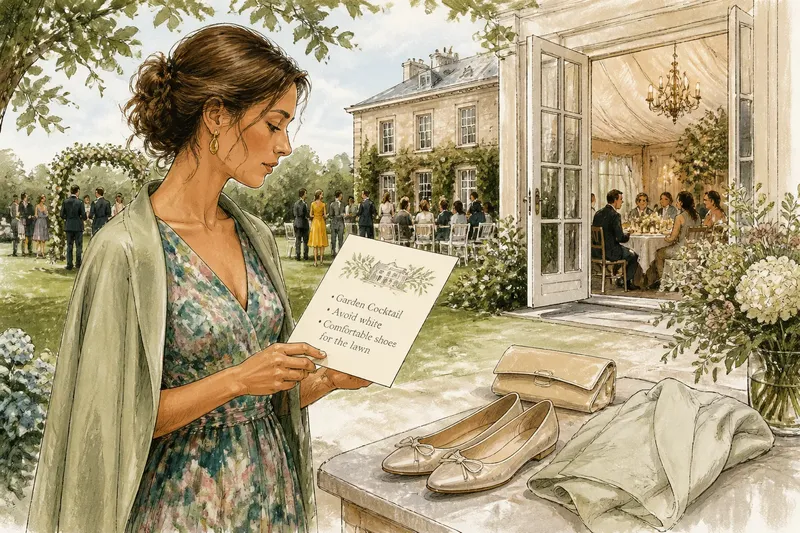
Consider this invented situation: you receive an invitation to a late-summer wedding at a country-house garden, followed by dinner indoors. The dress code says “garden cocktail”; a note asks guests to avoid white and to choose comfortable shoes for the lawn. Instead of treating those phrases as a puzzle with one correct answer, read them as clues about the event’s tone, practical conditions and the couple’s wishes.
What does the wording tell you?
Start by separating the dress code into its parts. “Cocktail” points towards clothes that feel occasion-ready without necessarily calling for evening dress. “Garden” gives useful context: the event includes an outdoor setting, so a long hem that catches underfoot or shoes that sink into soft ground may be awkward.
The phrase is not a universal prescription. One couple may use “garden cocktail” for a relaxed celebration with tailored separates; another may expect a more dressed-up look. Treat the wording as a boundary around the mood, then use the rest of the invitation to refine your choice.
Look for details that change how you interpret the label:
- Time: A daytime ceremony often reads differently from a late-evening reception. Consider how formal the full schedule feels, rather than relying on time alone.
- Venue: A garden, beach, restaurant or formal hall suggests different practical needs and social tones.
- Schedule: A ceremony followed by a long reception may call for an outfit that remains comfortable through both.
- Host notes: Requests about colour, footwear or cultural dress are more specific than broad conventions.
In the invented garden wedding, the outdoor ceremony and lawn note support a neat, celebratory outfit that can handle uneven ground. The indoor dinner means the guest need not dress as if the whole event were a casual picnic. Both settings count.
How should you weigh the host’s preference?
A dress code is an invitation to share the hosts’ occasion, not a test of whether you know every etiquette convention. Give a clear request more weight than a general rule you have heard elsewhere. If the couple asks guests to avoid white, choose another colour rather than debating whether a particular shade is technically white.
For the invented guest, the colour note rules out a pale ivory dress. It does not dictate a single replacement. A muted green, warm blue or patterned outfit could all fit, depending on what the guest already owns and feels comfortable wearing.
Sometimes the invitation leaves a real gap. If you are close to the couple, ask the person named for questions or a member of the wedding party. Keep the question narrow and easy to answer: “Would a tailored jumpsuit fit the garden cocktail dress code?” That is more helpful than asking the host to choose your outfit.
If asking is impractical, choose an option that sits comfortably within the invitation’s broad tone. Avoid using uncertainty as a reason to turn up in something conspicuously more formal or markedly more casual than the event appears to call for.
How formal does the occasion feel?
Formality comes from the combination of wording, setting and schedule. “Black tie” is a more explicit signal than “cocktail attire”, while “festive” or “smart casual” leaves more room for interpretation. A formal venue can add polish to a loosely worded invitation, but it does not automatically cancel the hosts’ chosen dress code.
For the garden wedding, imagine the guest has a patterned midi dress and a pair of polished flats. The dress feels celebratory, while the flats answer the lawn note without looking like everyday trainers. A light jacket can make the outfit work for the indoor dinner; there is no need to buy a new ensemble simply because the invitation uses a compound phrase.
Another guest might prefer trousers. A pressed, well-fitting pair with a refined blouse or shirt and smart shoes could convey a similar degree of care. The aim is to meet the occasion’s tone, not to reproduce one imagined uniform.
What should you do when the wording is unclear?
What does “garden cocktail” usually suggest?
It usually signals a polished party outfit suited to an outdoor setting, but the phrase does not set a universal standard. Read it alongside the venue, time and any notes from the hosts.
Can you wear trousers to a wedding with cocktail attire?
Often, tailored trousers can suit cocktail attire when paired with an occasion-appropriate top, jacket or shirt and considered footwear. The invitation’s formality and any cultural or host preferences should guide the choice.
What if the invitation gives no dress code?
Use the venue, time and schedule as clues, then choose something neat and suited to the event rather than assuming the most formal option. If you still cannot judge the tone, ask someone close to the couple a brief, specific question.
Should you follow an online dress-code chart exactly?
No chart can account for every host, venue or community. Use a chart as a rough translation of terms, then give the actual invitation and its requests priority.
How does the invented guest make a final choice?
Say the guest chooses the patterned midi dress, a light jacket and polished flats. The colours respect the request to avoid white, the shoes suit the lawn, and the jacket gives the look enough finish for dinner indoors. This is an invented example, not a rule that every garden wedding calls for a dress or flats.
The guest also checks that the outfit is comfortable to sit, walk and dance in, and that the jacket works with the dress rather than feeling like an afterthought. Those are practical checks, not extra dress-code rules. They make it easier to enjoy a long day without repeatedly adjusting a hem or changing shoes.
What is not worth the effort? Trying to decode every adjective as if each had a settled, formal definition. Spending hours comparing strangers’ interpretations online is unlikely to clarify what this particular couple means. A short conversation with the right person, or a sensible choice within the invitation’s tone, is usually more useful.
The useful lesson from the invented situation is to read the invitation as a whole: identify the clearest request, consider the setting and schedule, then choose an outfit that fits the implied level of formality. Reading the dress code on a wedding invitation this way leaves room for personal style without treating convention as a universal rule. If the hosts or local customs have specific expectations, follow those rather than relying on a broad generalisation.